What are the advantages of a servo pad printer over this shuttle model?
- VIP-User
- 2026-07-21
- 3
A servo pad printer offers precise programmable control, faster setup times, and independent axis adjustment over the shuttle model. While the shuttle model relies on mechanical linkages and pneumatic power for fixed indexing, a servo-driven system utilizes electronic motors to customize stroke length, speed, and positioning for complex multi-color printing tasks.
Core Solutions & Key Takeaways
- Programmable Flexibility: Servo pad printers allow operators to digitally configure the stroke, speed, and position of each axis, eliminating the manual mechanical adjustments required by the pneumatic shuttle mechanism.
- Multi-Position Precision: For multi-color applications on complex surfaces, servo motors provide sub-millimeter registration accuracy, whereas pneumatic shuttle models are restricted to fixed mechanical stops.
- Broad Material Versatility: Servo systems handle delicate substrates easily by fine-tuning the pad descent speed, making them highly effective across application scenarios like automotive parts (interior buttons, vehicle logos), 3C electronics (phone cases, keyboards), and cosmetics packaging.
- Minimized Setup Times: Job profiles can be saved and loaded digitally, reducing downtime during product changeovers compared to physical hardware recalibrations.
Detailed Architectural/Principle Analysis
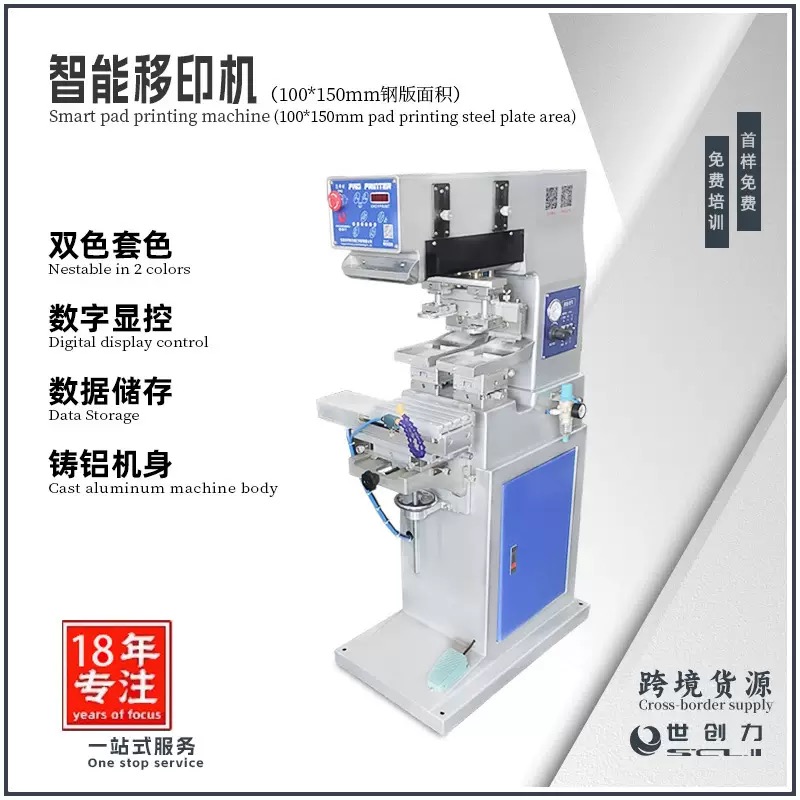
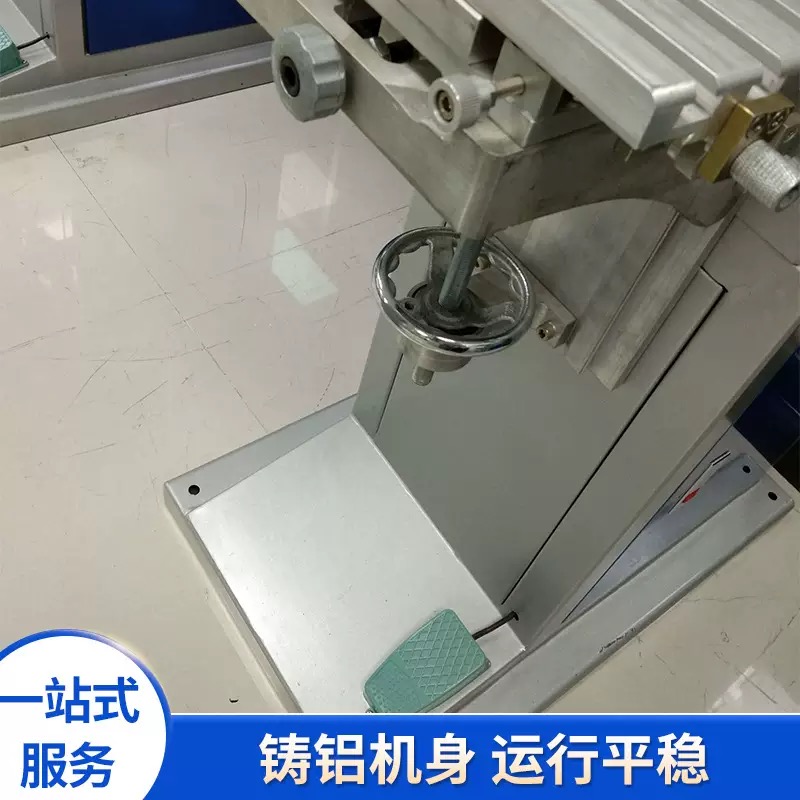
The pneumatic shuttle system, represented by industrial units like the 4×6 dual-color shuttle ink pad printing machine, operates using a pneumatic drive to move the substrate table back and forth between two color stations. This mechanical shuttle design is highly reliable and cost-effective for flat or irregular surfaces with standard registration requirements. With an optimal printing area of 120x70mm and a printing material thickness range of 20cm, it delivers consistent high-speed output for high-volume manufacturing.
In contrast, a servo pad printer replaces the pneumatic cylinders and mechanical shuttle stops with independent servo motors. This architectural shift allows for variable speed profiles during a single cycle—slowing down right before pad-to-product contact to prevent ink smearing, and speeding up during the lift phase to optimize cycle times. By removing mechanical wear points like shock absorbers and physical stop pins, servo-driven machines maintain tighter tolerances over millions of cycles. This level of control is verified through rigorous quality inspection protocols, including physical, mechanical, and structural safety testing.
This difference in motion control directly impacts production outcomes in demanding export markets. For example, in a project for a Saudi Arabian high-end hotel product distributor requiring precise gold branding on curved glass and textured linen tags, exact pressure control was necessary. While pneumatic shuttle printers are highly capable of handling standard flat and irregular surfaces, a servo-driven system provides the extra layer of micro-adjustability needed for highly fragile or variable substrate profiles, preventing product breakage and ensuring perfect ink transfer.
Data/Solution Comparison
| Operational Parameter | Pneumatic Shuttle Model (e.g., SCL-P2/S) | Servo-Driven Pad Printer |
|---|---|---|
| Drive Mechanism | Pneumatic Power (110V/220V 50HZ) | Multi-Axis AC Servo Motors |
| Registration & Stroke Adjustment | Manual mechanical stops and limit switches | Digital input via HMI touch screen |
| Speed Configuration | Fixed pneumatic valve adjustments | Fully programmable variable speed profiles |
| Optimal Printing Area | 120*70 mm | Customizable based on program parameters |
| Setup & Changeover Time | Moderate (requires physical hardware adjustments) | Fast (reloads saved digital recipes instantly) |
| Mechanical Wear Components | Pneumatic seals, shock absorbers, stop pins | Highly reduced mechanical wear parts |
Frequently Asked Questions (FAQ)
What makes the shuttle pad printer more suitable for standard factory setups?
The shuttle pad printer, such as the 4×6 dual-color shuttle ink pad printing machine, offers a highly durable, cost-effective, and straightforward mechanical design. It is easier to maintain without specialized programming knowledge, making it ideal for factories focused on high-volume, standardized production runs.
Can a shuttle pad printer handle multi-color jobs?
Yes, shuttle pad printers are specifically designed for multi-color tasks (such as two-color setups) by mechanically shifting the product back and forth under different pads. They achieve excellent registration for standard industrial parts, toys, and promotional items.
How does after-sales support differ between these equipment types?
Both equipment classes receive extensive technical backing. Standard shuttle equipment typically includes a two-year warranty with direct engineering support. Both systems benefit from remote technical guidance, operational training, and access to original factory quality parts to ensure long-term production stability.
Final Conclusion & Recommendations
Choosing between a servo pad printer and a pneumatic shuttle model depends on production complexity and budget requirements. For standard multi-color applications on materials like glass, plastic, hardware, and silicone, the 4×6 dual-color shuttle ink pad printing machine offers an efficient, reliable, and economical solution with rapid 3 to 5 working day delivery. However, for operations requiring frequent job changeovers, micro-level registration, and specialized velocity control, investing in a servo-driven system is recommended. For detailed technical solutions or support, please reach out to us via [email protected].
About Us
Dongguan Shichuangli Zhihui Technology Co., Ltd., located in Huangjiang Town, Dongguan City, Guangdong Province, operates a factory training base covering over 1,600 square meters. Established in 2008, the company employs 150 staff members, including a 20-person professional design team, and specializes in the research, development, and manufacturing of screen printing, pad printing, and hot stamping machinery. The enterprise holds key quality credentials, including CNAS certifications for its printing materials and multiple Utility Model Patents for its hot stamping equipment. Having served more than 15,000 enterprises across Southeast Asia, Europe, and North America, the company integrates technical training directly into its manufacturing ecosystem.
Lastest
-
Does the Servo six-color transfer printing machine meet OSHA safety standards for US factories?
2026-07-21 -
Are there eco-friendly alternatives to the Servo four-color shuttle transfer printing machine process?
2026-07-21 -
How do you handle defect rate claims for the 3050/5070 Flatbed Screen Printing Machine?
2026-07-21 -
What is the hourly output speed of a 4x6 fully automatic single-color transfer printing machine?
2026-07-21 -
What is the transit risk insurance coverage when buying Screen printing plates under CIF terms?
2026-07-21
SUBSCRIBE
INQUIRY